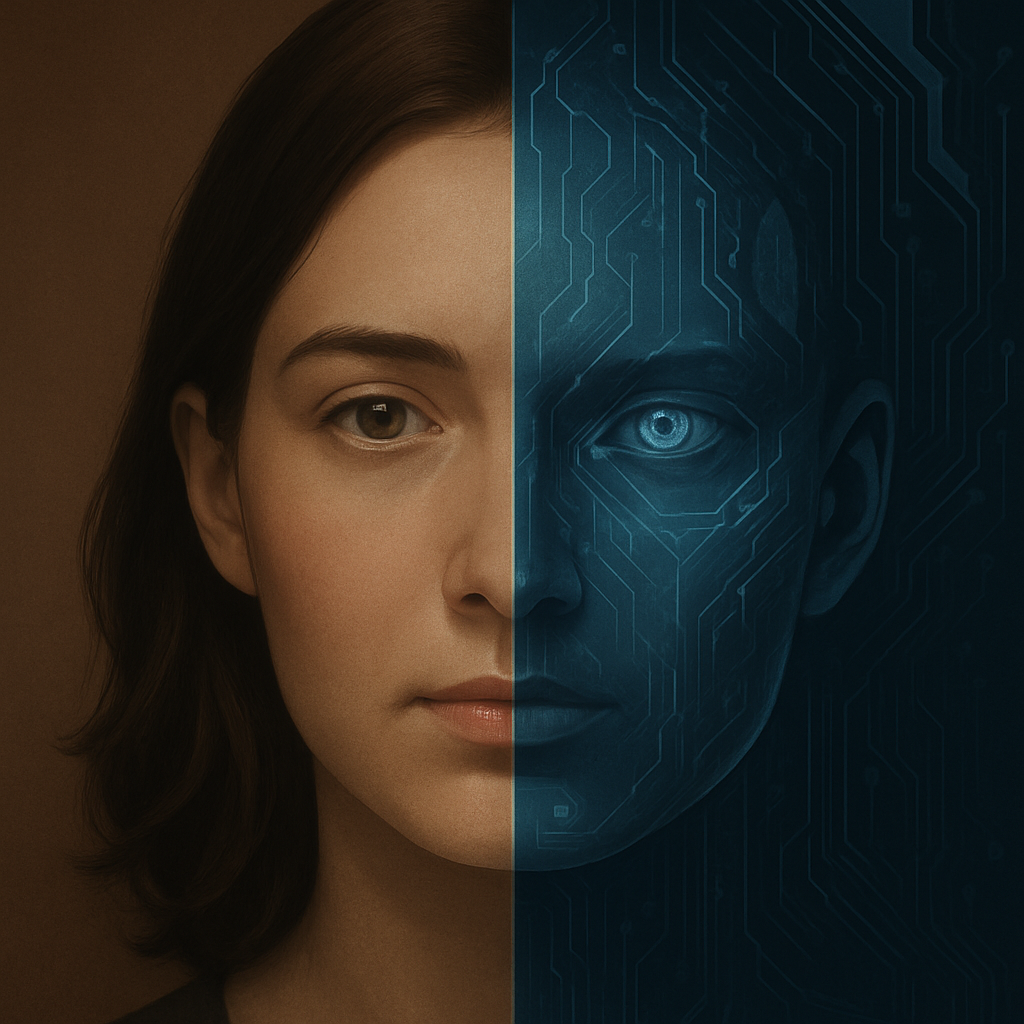
Artificial intelligence is quickly erasing the visual boundaries between human and machine creation. Photorealistic faces, lifelike motion, emotional performances, AI can now generate them all.
For those who study or create with these tools, there’s still a subtle uncanny valley. But that gap is shrinking fast. Soon, no one will be able to reliably “spot the fake.”
So what happens to cultural differentiation, the idea that we can tell, sense, or value the human touch?
The answer lies beyond detection. It lies in meaning.
1. From Detection to Meaning Recognition
The old way of identifying AI was technical: mismatched eyes, extra fingers, wrong reflections.
That won’t work much longer.
But even when the surface is perfect, humans will still crave authentic presence, the feeling that a piece of work emerged from lived experience, not probability.
Audiences will start asking unconsciously:
“Do I feel a person behind this?”
“Is there intention, risk, or emotional cost here?”
We’ll begin to judge authenticity by emotional resonance, not visual artifacts.
2. Provenance Becomes Part of the Art
When imitation becomes flawless, origin becomes aesthetic.
Artists will weave provenance into their storytelling, showing sketches, process clips, handwritten notes—as proof of human participation.
That behind-the-scenes texture will matter as much as the finished work.
Imperfect brushstrokes, breathing in a vocal take, digital fingerprints of choice, all become marks of authenticity in an otherwise machine-perfect world.
As technology perfects imitation, imperfection will become art’s final frontier.
3. Emotional Depth vs. Emotional Realism
AI can simulate emotional realism, expressions, tone, and pacing that look and sound true.
But emotional depth, the kind born from memory, loss, and love, can’t be faked.
Humans create from why; machines create from what.
That distinction, subtle as it may be, will remain felt even if it’s unseen.
Audiences may not always articulate it, but they’ll respond differently to something that was lived before it was written.
4. Trust and Context Replace Visual Cues
In a world where realism is undetectable, context becomes the new authenticity.
We’ll rely on:
- Verified creators with traceable identities
- Platforms that guarantee human provenance
- Direct artist-to-audience trust relationships
Truth will shift from “what looks real” to “who do I trust.”
It’s the same evolution journalism faced after deepfakes, credibility became relational, not visual.
5. Deception, Awareness, and New Art Forms
As AI’s mimetic power grows, so will artistic self-awareness.
Some creators will blur the boundary intentionally, making art that asks, “Was this human or not?”
That ambiguity itself becomes commentary on authorship and reality.
Just as surrealism redefined what could be painted, this new wave will redefine what it means to believe an image.
6. The Future of Cultural Differentiation
Cultural differentiation will survive, but not because humans can outdraw or outperform AI.
It will survive because we create for reasons AI cannot replicate, to confess, to question, to grieve, to hope.
The audience of tomorrow won’t care whether a piece looks human-made.
They’ll care whether it feels alive.
Authenticity will migrate from the eye to the heart.
7. The Takeaway
When realism is universal, meaning becomes the last form of originality.
AI can generate beauty, but it can’t intend it.
Human creativity endures where art meets vulnerability—where someone dared to express something only they could feel.
The next era of cultural literacy won’t teach us to spot fakes.
It will teach us to recognize the soul in what’s real.
Author: Gabriel A. Segoine

Gabe Segoine is the founder of LNKM and author of Surfing North Korea. He spent over a decade in Northeast Asia doing humanitarian work focused on the DPRK. Gabe now writes about culture, faith, and emerging AI from a deeply human perspective. His book Surfing North Korea and Other Stories from Inside can be found on Amazon.