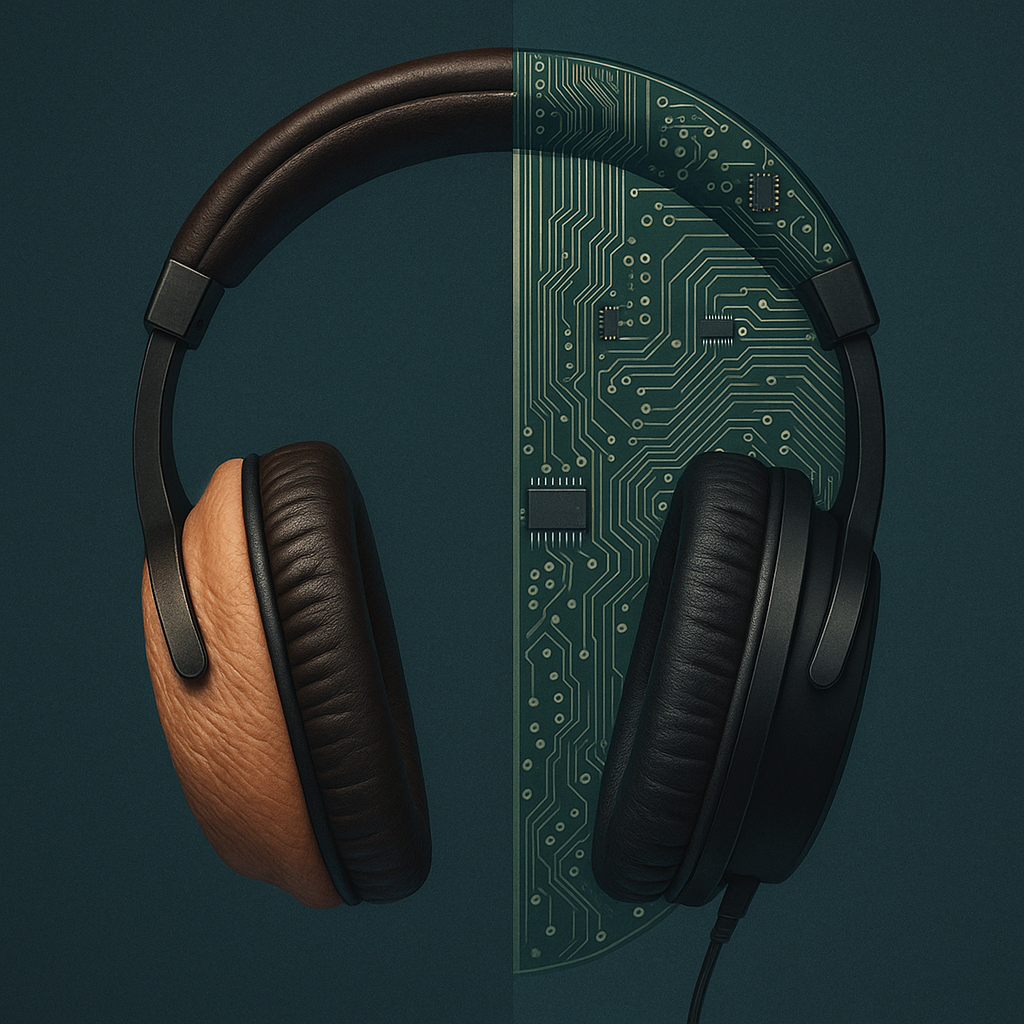
I recently listened to a song called “Walk My Walk” by a supposed band named Breaking Rust. The vocals were powerful, polished, confident, and radio-ready. But something didn’t sit right with me. Not because the song was bad — in fact, it was surprisingly well-produced, but because it gave me that eerie sense of technical perfection without personality.
Right around that time, I read a new Deezer–Ipsos global survey, and it confirmed exactly why my instinct was firing:
97% of listeners could not tell the difference between AI-generated music and human-made music in a blind test.
That’s not a small margin. That’s nearly everyone.
And if almost everyone can’t tell the difference, then we need new skills, not just musical knowledge, but cultural literacy to help us identify the presence (or absence) of humanity in the music we hear.
Before we dive into the top ten ways to spot AI music, here are the key insights from the survey that started this whole exploration.
🔍 What the Global Deezer–Ipsos Survey Reveals (9,000 Respondents)
- 97% couldn’t distinguish AI music from human music
- 52% said this made them uncomfortable
- 66% would listen to AI songs out of curiosity
- 45% want the ability to filter out AI
- 40% would skip AI songs automatically
- 80% want clear AI labeling
- 73% want to know when recommendations include AI
- 52% believe AI songs should not appear in human music charts
- 65% say copyrighted material shouldn’t be used to train AI
- 70% say AI threatens musicians’ livelihoods
- 69% believe AI music should receive lower payouts
Source: Deezer–Ipsos Survey, Nov 2025
This tells us something important:
People care deeply about whether the music they’re hearing has a real human behind it. But most people don’t know how to tell.
So from my own experience, here are the Top 10 Indicators you can use (for now) to determine whether a song was created by AI. I have them ranked from least important (#10) to most definitive (#1).
THE TOP 10 INDICATORS OF AI-GENERATED MUSIC (DESCENDING ORDER)
#10 — Song Length (AI Struggles Beyond 3 Minutes)
Let’s start with the least important but still reliable clue.
AI tends to generate songs around three minutes, because that’s the most statistically common length in its training data. When pushed beyond that, songs may lose structure:
- repetitive loops
- no bridge development
- weak transitions
- no emotional arc
That’s why AI doesn’t produce multi-part compositions like Bohemian Rhapsody or Good Vibrations.
It’s improving, but for now, short length is a soft indicator.
#9 — Genre Blending Without Cultural Context
AI doesn’t understand what “genre” means. It only knows how genre looks statistically.
When I listened to “Walk My Walk,” I found myself subconsciously asking:
“Is this supposed to be country… or not?”
It sort of sounded country and the vocal tone hinted at Jelly Roll or Chris Stapleton, but the rhythm, phrasing, and energy didn’t feel right. It didn’t feel rooted in the lived culture of country music.
This is what AI often produces:
- genre-adjacent vocals
- mismatched instrumentation
- stylistic combinations with no cultural grounding
It’s music that can be in the neighborhood, but not in the house.
When you find yourself asking:
“What genre does this music belong to?”
that’s a sign you’re listening to AI.
#8 — Weak, Missing, or Cloned Harmonies
AI can produce breathtaking lead vocals, but harmonies remain a weak spot.
Signs include:
- background vocals that sound like pitch-shifted clones
- harmonies that lack emotional interplay
- missing harmonies where a human would naturally add them
- mathematical correctness without artistic intention
Human harmonies reflect personality, blend, breath, culture, and story.
AI harmonies reflect none of those.
#7 — Emotional Flatness or “Unearned Emotion”
AI can mimic emotion, but it cannot earn it.
Human songs draw from:
- lived experience
- pain
- joy
- memory
- complex inner worlds
AI-generated songs can sound emotional, but the emotion often feels ungrounded:
- big swelling choruses with no narrative payoff
- dramatic vocal moves without a story
- “sad” or “angry” lyrics with no lived context
You feel this as:
“This wants to be emotional, but it doesn’t make me feel anything.”
It’s the difference between imitation and lived truth.
#6 — No Breath, No Body, No Physicality in the Vocals
AI vocals lack the physiology of human singing.
Humans use:
- lungs
- diaphragm
- physical effort
- strain
- fatigue
- real inhalation patterns
AI uses none of that.
So AI vocals often have:
- no breaths before difficult phrases
- no shift in tone during strenuous notes
- no micro-cracks
- no physical “push” in belting
- no evidence of a living body behind the voice
Even the best AI vocals float a little too effortlessly.
#5 — Cliché Lyrics
AI’s Achilles heel.
Good human songwriters spend significant time avoiding cliché.
Songwriting is a process:
- drafting
- discarding
- refining
- chasing authenticity
But AI doesn’t know what is cliché or original, it only knows what is common.
And here’s the key problem:
People prompting AI to write lyrics often aren’t songwriters themselves.
So:
- AI produces cliché lines
- the prompter doesn’t recognize them
- the clichés go unedited
- the song ends up lyrically shallow
I suspect that’s what happened with “Walk My Walk.”
Several lines felt like they came straight from a stack of overused songwriting templates, which is something a seasoned songwriter would reject instantly.
AI isn’t incapable of writing better lyrics, but without a human songwriter’s instincts, clichés can slip right through.
#4 — Weird Mispronunciations or Vocal Artifacts
AI suffers the audio equivalent of the “six-finger problem” in visual AI.
To be fair, “Walk My Walk” didn’t have mispronunciations.
But many AI songs do — and they can be glaring:
- vowels bend unnaturally
- syllables get swallowed
- stress lands on the wrong part of the word
- a line sounds warped or “melted”
I’ve made songs with AI myself where one bad pronunciation ruined the entire performance. No amount of mixing can fix a fundamentally broken syllable.
This issue is improving fast — but right now, if you hear something that makes you think:
“A human wouldn’t say it that way…”
it’s a major clue.
#3 — The “Would I Listen Again?” Test
This is one of the clearest markers of human heart.
Ask yourself:
Would I actually listen to this again?
Would I add it to a playlist?
Does it pull me back?
Does it linger?
Like the AI produced video slop we are currently seeing all over social media, AI-generated music tends to be one-and-done. Interesting in the moment, but rarely worth revisiting.
As someone who has written original songs and produced them using AI, I’ve found that my AI-produced songs are somewhat different from fully AI written and produced songs. Maybe I’m biased (that’s always possible) but I genuinely enjoy listening to them again and again. Not because the AI vocal is flawless (it isn’t), but because: there’s a human heart behind the lyrics.
The words came from me.
The story came from me.
The soul in the writing came from me.
If you want to check out my songs on YouTube, they can be found here:
And interestingly, my wife agrees. She enjoys listening to those songs on repeat, even though:
- the vocals are AI
- the production is AI
- the instrumentation is AI
- the entire execution is synthetic
But the meaning came from a human.
The emotional core came from a human.
The artistic intention came from a human.
And that affects how a song lands.
Of course someone else’s mileage may vary, but this points to a key insight:
An AI-produced song can still feel “re-listenable” if the human heart is present in the writing process.
So the “Would I Listen Again?” test is not only asking whether the vocals and production are compelling, it’s also asking:
Was there a human behind the lyrics?
Was there a real story?
Was something alive in the creation process?
If the answer is no, if there’s no humanity anywhere in the pipeline, then the desire to replay the song tends to vanish.
#2 — Too Perfect
AI’s extraordinary flaw is that it performs too flawlessly.
“Walk My Walk” is an extremely difficult vocal performance:
- fast delivery
- tricky transitions
- demanding phrasing
- zero room for timing errors
A human singer would need hundreds of hours of practice to nail it. Even then, it would take many takes in the studio.
But AI gets it right immediately.
(Or close enough on the first try.)
AI doesn’t breathe.
AI doesn’t crack.
AI doesn’t hesitate.
AI doesn’t struggle.
AI doesn’t get tired.
It just outputs perfection.
And here’s the truth about music:
It’s the imperfections that make music human.
AI perfection feels sterile, mechanical, and “too smooth.”
Human performances carry the beauty of effort.
When a vocal sounds impossibly perfect, that’s a major giveaway.
#1 — World-Class Vocals Attached to Nobody
The biggest, clearest, most definitive indicator.
If you hear:
- a world-class vocal
- an elite-level performance
- a voice comparable to major stars
- but no person attached to it
…it is almost certainly AI.
Because real world-class singers:
- have names
- have interviews
- have a presence
- have history
- have performances
- have faces
AI vocalists do not.
This was my immediate red flag with “Walk My Walk.”
The voice was incredible — a mix between Jelly Roll and Chris Stapleton — but tied to absolutely nobody who actually exists.
When we hear world famous voices, we know who they belong to. You knew Whitney Houston was Whitney Houston. You know Mariah Carey is Mariah Carey. I could go on and on.
When a voice sounds like it belongs on a stadium stage yet belongs to a ghost?
That’s your #1 tell it’s AI.
Why All This Matters: The Human Heart and the Human Source
Here’s what I believe is the key perspective we need to keep in mind as we move forward with AI: AI-generated content can have value, but the value doesn’t originate from the AI — it originates from us humans.
AI only knows what it has been trained on. It’s remixing human creativity, human music, human language, human emotion. So the real question isn’t:
- “Can AI create meaningful music?”
It’s:
- “Where is the human heart behind this?”
AI produces second-hand creativity.
Humans produce first-hand creativity.
And that’s why we need to learn the difference. Not to completely reject AI, but to recognize and value the irreplaceable humanity behind real art.
AI content often feels good for a moment, then disappears.
Human art is what we return to.
Human art is what we remember.
Human art is what we feel.
Human art is what lasts.
As AI continues to flood the creative world, these ten indicators may help us stay anchored to what’s real, what’s human, and what matters.
AI will get better.
Humans will adapt.
But the human heart will always matter, and learning to recognize the difference may become one of the most important artistic skills of our lifetime.
Gabe Segoine
Gabe Segoine is the founder of LNKM and author of Surfing North Korea. He spent over a decade in Northeast Asia doing humanitarian work focused on the DPRK. Gabe now writes about culture, faith, and emerging AI from a deeply human perspective. His book Surfing North Korea and Other Stories from Inside can be found on Amazon.