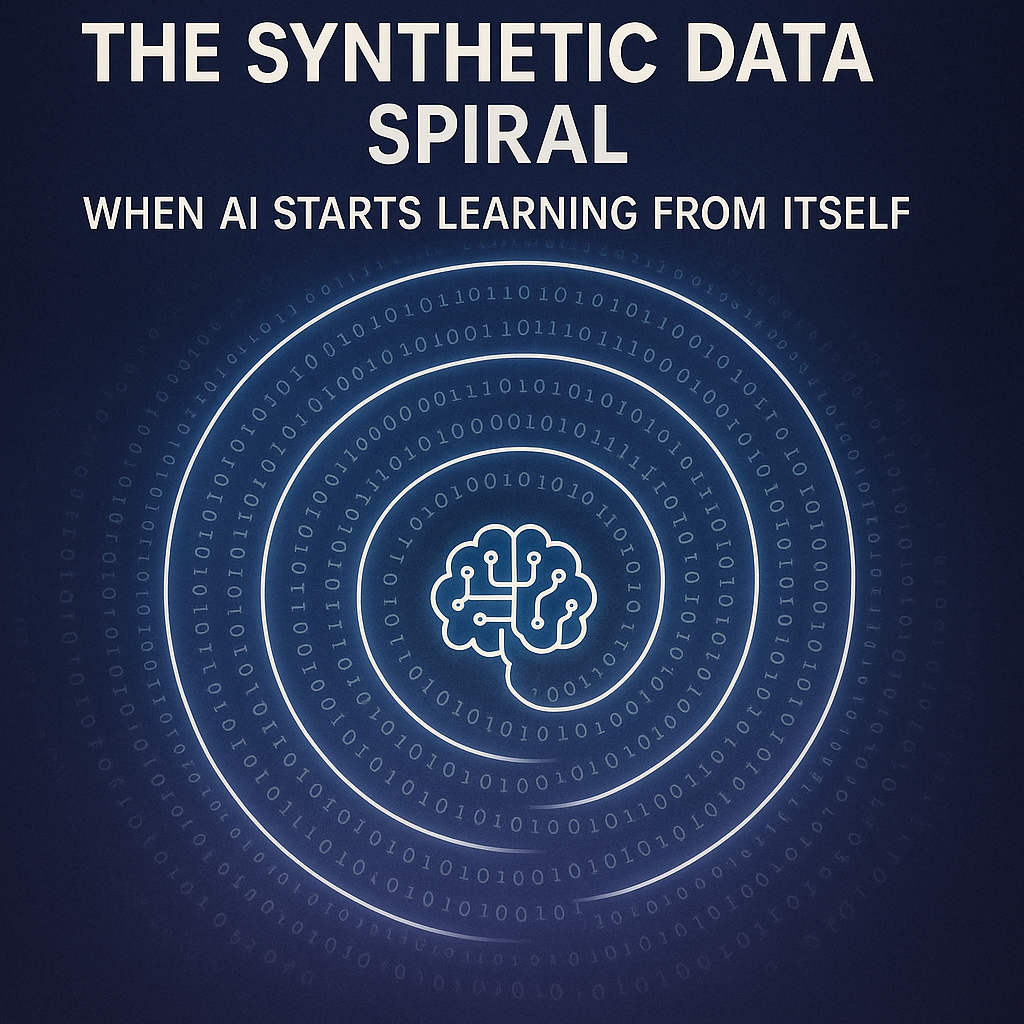
The web once served as a vast record of human imagination—billions of words, photos, and songs reflecting real experience.
Now, a growing share of that content is produced by machines. AI tools generate blog posts, music, illustrations, and even films, and then new models train on that output.
This self-referential cycle is called the synthetic data spiral, and it’s reshaping the future of creativity.
1. What Synthetic Training Data Really Means
Generative models learn from examples. When those examples were mostly human—novels, paintings, videos—their training mirrored authentic thought.
As AI output becomes ubiquitous, new models begin learning from earlier synthetic material.
The result: a feedback loop.
Each generation copies slightly smoother, slightly emptier versions of human style—like dubbing a cassette one too many times until the hiss replaces the soul.
2. The Emerging Split: Organic vs. Synthetic
Two parallel trends are forming.
A. Closed, verified datasets
Publishers and creators are starting to protect their “organic” data: curated text, art, and code tagged as human-made. Expect:
- paid data cooperatives for licensing creative work,
- provenance or blockchain tagging to prove authorship,
- “nutrition labels” listing data sources for AI models.
B. Synthetic-to-synthetic ecosystems
At the same time, some AI developers are embracing synthetic data deliberately to create tightly controlled specialist models—legal research, product design, simulation. These won’t need artistic novelty, just accuracy and speed.
The digital landscape is dividing into creative soil (human-seeded) and industrial scaffolding (machine-refined).
3. The Human Cutoff Point
There won’t be a single line separating human and AI creation; instead, society will branch into three creative cultures:
- Integrated creators who use AI like an instrument—fast drafts, visual aids, idea expansion—with final vision still guided by people.
- Automated producers who delegate entire workflows to AI for cost or scale.
- Authenticity artisans who reject automation altogether, branding their work as human-made originals.
In a few years, “handcrafted digital art” could carry the same cachet as “farm-to-table” food.
4. The Retreat From the Open Web
As AI scraping grows, artists are already pulling back. Illustrators delete portfolios, photographers limit resolution, writers move to paid newsletters or closed communities.
If that continues, the open internet may become a synthetic echo chamber—an endless remix of AI-made media—while authentic creativity migrates behind paywalls and private networks.
It’s the same divide that transformed journalism and music: abundance for free, quality for a fee.
5. Finding Equilibrium
Three forces could restore balance:
- Provenance infrastructure: universal watermarking or cryptographic fingerprints confirming who—or what—made each work.
- Regulation and licensing: fair compensation or consent frameworks for training on human material.
- Cultural literacy: audiences learning to value the texture of imperfection that only humans create.
The likely outcome is a hybrid web:
AI generates most utilitarian content, humans remain the source of originality and emotion.
6. The Irony at the Core
AI’s long-term survival depends on us.
If people stop creating publicly, the models will lose their richest data stream.
Human unpredictability—the odd phrase, the flawed sketch, the gut-level intuition—is the one thing machines can’t synthesize.
Protecting and rewarding that spark may prove more important to the future of AI than any new algorithm.
7. The Takeaway
As artificial intelligence learns from its own reflections, the world risks a smooth, endless sameness.
The antidote isn’t banning the technology—it’s keeping humanity in the loop: creators who dare to surprise it, confuse it, and teach it new ways to see.
Our imperfections are the raw data of progress.
Gabriel A. Segoine
Gabe Segoine is the founder of LNKM and author of Surfing North Korea. He spent over a decade in Northeast Asia doing humanitarian work focused on the DPRK. Gabe now writes about culture, faith, and emerging AI from a deeply human perspective. His book Surfing North Korea and Other Stories from Inside can be found on Amazon.